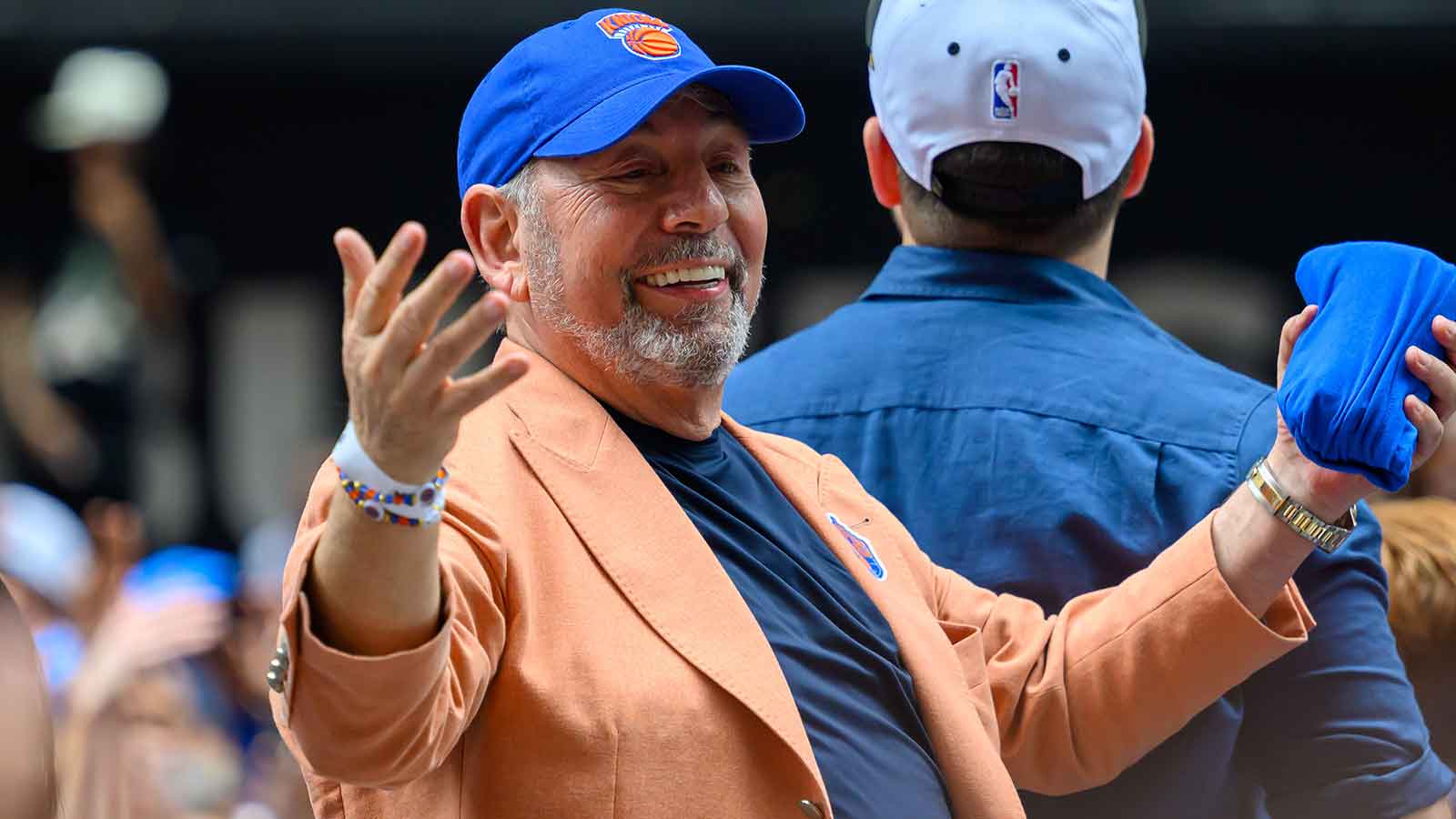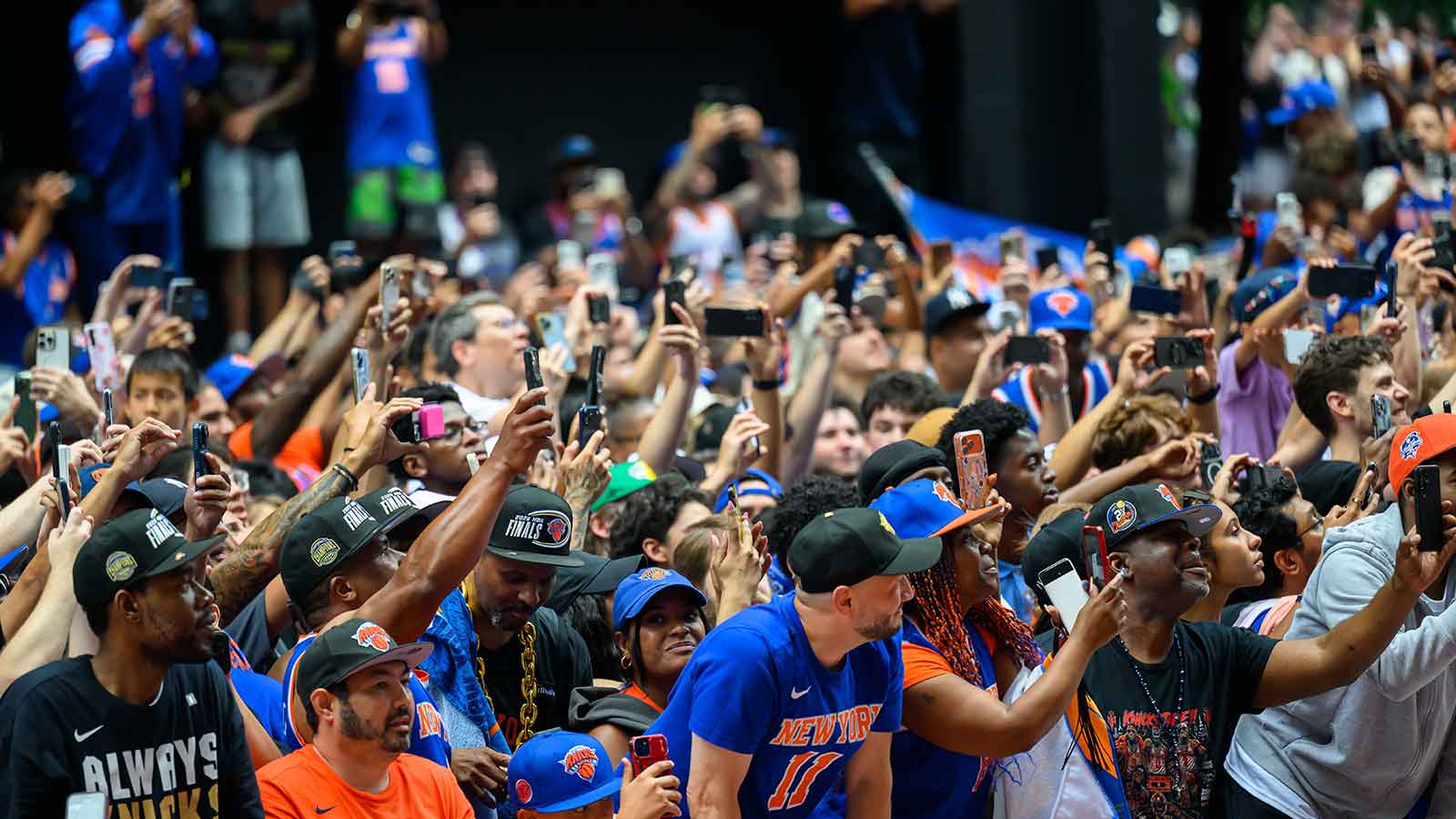
When the 2026-27 season tips off, the New York Knicks will look to defend their first NBA title in 53 years. Most of the team's core is in place for the immediate future. But a few important role players will face major free agency decisions. And the obstacles presented by re-signing all of its role players was made clear when team owner James Dolan recently expressed his desire to avoid going over the dreaded second apron in a recent interview.
However, just like he did in the 2026 NBA Finals, Karl-Anthony Towns may swoop in to save the day regarding the Knicks' salary dilemma.
Karl-Anthony Towns contract situation
Towns' contract is good for $57 million in 2026-27. He owns a player option worth roughly $62 million for 2027-28; however, he can just as easily opt out of his player option and re-sign with New York this summer.
Sure, Towns has flipped the narrative around himself on its head. He's received credit for more than just his scoring, being credited as a strong defender and rebounder—and even recently getting credit for being a good teammate, too. But while Towns may have earned a bigger payday, he recently suggested an openness to taking a similar pay cut to that taken by Jalen Brunson in a recent interview with Club Shay Shay.
If Towns opts out of his player option, he will be eligible to sign a four-year, $272 million deal. Accepting a $100 million pay cut brings that number down to four years at $172 million. That works out to approximately $43 million per year. It represents considerable savings for 2027-28. And it would likely start even lower than $43 million, given the nature of contracts and annual raises in the NBA.
Knicks may have to cross the second apron – but not for long
Getting Brunson to take a $100 million pay cut set the table for the Knicks' salary future. And getting Towns to take a similar $100 million pay cut benefits the Knicks exponentially more, enabling significant wiggle room for New York's front office. However, there are still challenges abound.
The second apron for 2026-27 will sit at $222.372 million. That means that the Knicks must stay below it to avoid the punitive nature of the league's new Collective Bargaining Agreement. Exceeding the second apron triggers a number of penalties. Those penalties include an inability to aggregate multiple contracts in trades and an inability to send cash out in transactions. It also results in the loss of all mid-level exceptions. And it results in penalties around draft picks, as well.
So, how does Towns pay cut help the Knicks? Assuming for the moment that Jose Alvarado opts in to his $4.5 million player option, New York is on the hook for $205.457 million. New York could save approximately $3 million by moving Pacome Dadiet. That brings their obligations down to about $202 million. However, adding the first-year salary for Mohamed Diawara – $3.2 million – washes any savings from Dadiet. And the Knicks must also consider new contracts for Mitchell Robinson and Landry Shamet.
Signing Robinson to a deal that pays $18 million next season feels reasonable. And adding a Shamet contract that starts at $8 million puts the Knicks at about $231 million. That is around $9 million over the second apron at $222 million.
How might the Knicks walk this challenging tight rope? They could technically move Miles McBride and Tyler Kolek. That would save as much as $6.252 million for 2026-27. But that only brings New York down to about $225 million.
Further, New York would have only nine players under contract. They would have to sign five more players at veteran minimums. Thus, trying to fight to get under the second apron might be futile, whether Dolan likes it or not.
Could the Knicks dip back under the second apron in 2027-28?
The beautiful part about Towns potentially taking a pay cut is that New York can remain under the second apron in the long term. Even if they exceed the second apron for 2026-27, they could get back below it for the following season, avoiding those punitive draft penalties.
The second apron is calculated as 134.4% of the salary cap. While numbers are not yet final for the 2026-27 season, it works out to approximately $233 million for that season as it currently stands.
Separately, assuming the moves for Towns, Robinson, and Shamet mentioned above, the Knicks are on the hook for approximately $220 million in obligations in 2027-28 for eight players. New York would have to add six additional players via minimum deals. But thanks to the team's 2026 draft night moves, the Knicks own three second-round picks in the 2027 NBA Draft.
Full veteran minimum deals carry a cap hit of $2.45 million for 2026-27, whereas rookie minimums will carry approximately $1.5 million per year. Therefore, the Knicks could potentially sign three minimum rookie deals and three veteran minimum deals for 2027-28. That fills the roster out with a good mix of experience and youth. And it would keep their salary a hair under $233 million. In other words, New York would just avoid the second apron.
The second apron is internationally punitive. Remaining below it while competing – and winning – is an obvious challenge. And while the Knicks may not be able to remain below it for 2026-27 if they want to bring back all their major contributors, there is a very real path to getting back below it for 2027-28. And while eclipsing the second apron in any way is a deterrent, getting back below it is just as important. That looks entirely possible—and it starts with Towns accepting a pay cut.