
In his second season with the team, Pat Kelsey has a chance to lead Louisville to its highest seed in the 2026 ACC Tournament since the Rick Pitino era unceremoniously ended nearly a decade ago. Kelsey's revival of the program has made him a hot commodity among Cardinals Nation, but he still has a little bit to go before bringing them back to national title contention.
Louisville's hot-and-cold play has it just seventh in the ACC, despite being ranked No. 21 in the AP Top 25 poll. However, the Cardinals have been on a tear to start February, winning their last five games and embarking on their longest win streak since beginning conference play.
Kelsey's team was in an even worse position in the ACC standings before turning its season around. Despite a rocky month of January, Louisville is 7-1 in its last eight games midway through February, with its only loss in that frame against No. 4 Duke.
The Cardinals' midseason surge can be almost directly attributed to freshman guard Mikel Brown Jr., who has quickly become one of the best scorers in the country. Brown had been a boom-or-bust guard early in the season but has been on an incredible three-game run, spurred by his career-high 45-point performance against NC State on Feb. 9. Brown is averaging 34.3 points while shooting 60 percent from deep in his last three games.
Overall, all but one of the Cardinals' first six losses have come against top-25 opponents. Louisville is an elite team whose efficiency behind the arc makes it difficult to defend, but it has had a clear ceiling through the first three months of the 2025-2026 college basketball season.
Three-point game has been a double-edged sword
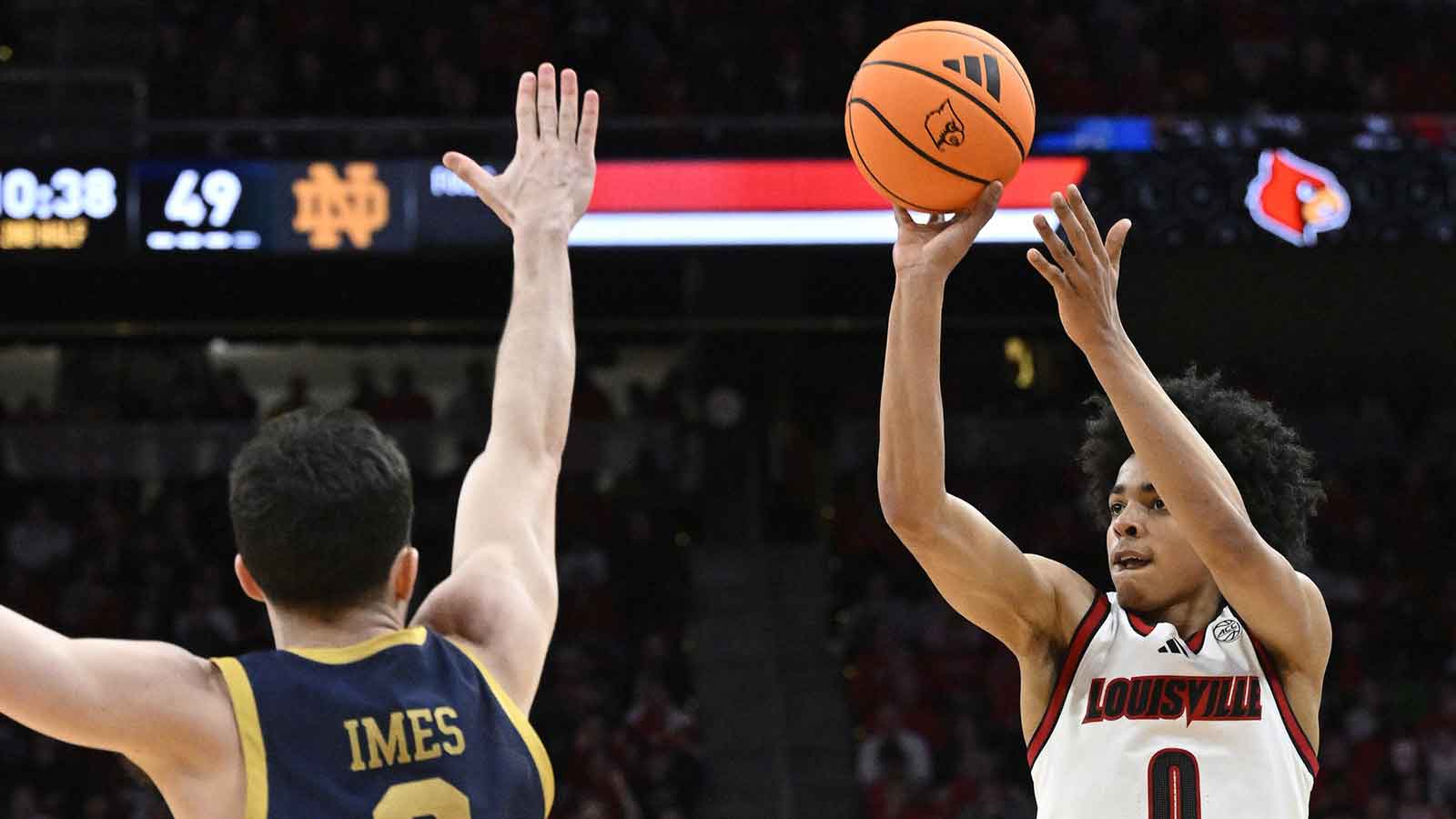
When Louisville's offense is rolling, it is arguably the best three-point shooting team in college basketball. The Cardinals average the second-most three-point attempts in the country and rank third with 11.6 three-pointers per game. Their three-point prowess is the driving force behind their stellar 124.9 offensive rating, which ranks 13th nationally on KenPom.
While Louisville's offensive efficiency often puts a lot of pressure on opposing teams, its reliance on the three-point shot has been a double-edged sword at times. The Cardinals lack a Plan B when the three-ball is not falling, which has been their downfall on multiple occasions.
Louisville averages 11.79 three-pointers made per game in their first 19 wins, hitting 39 percent of their shots from behind the arc during those games. Those numbers would be the best in the country, but the script has been completely flipped in their losses.
In their first seven losses, the Cardinals have averaged only 9.57 three-pointers per game on a dreadful 29 percent clip. Those numbers reflect in Pat Kelsey's star guards, Ryan Conwell and Mikel Brown Jr., who have shot just 27 percent and 25 percent from distance in their losses, respectively.
Like most teams that rely on the three-point shot, Louisville is streaky, with its success hinging on avoiding cold nights. Their play style allows them to beat the biggest fish in the sea on a good night, while they are just as likely to lose to subpar opponents on an off day.
Champions find ways to win on their worst nights, which the Cardinals cannot do. Louisville can get hot enough to pull off the ACC Tournament upset, but the best in the conference have been able to shut down its outside game and remove its right hand.
Louisville's inconsistent defense lacks discipline

The three-point game can also hurt Louisville on the other end, where it allows teams to attempt nearly as many shots as it does. The Cardinals truly have a love-hate relationship with the three-point arc on both sides of the floor.
Louisville's defense is solid all-around, with its 98.1 defensive rating ranking 28th on KenPom. The Cardinals only allow opponents to shoot 40.3 percent from the floor, 19th in the country, while allowing just 70.9 points per game.
But if there is one Achilles heel to Pat Kelsey's defense, it comes behind the arc.
Louisville does not allow opponents to hit three-pointers at a high rate — teams have made 32.3 percent of their long-distance attempts against it — but its defense funnels attempts from the perimeter. The Cardinals allow 22.4 three-point attempts per game, leading to their allowing 7.9 three-pointers per game, which ranks 203rd in the country.
Louisville is not known for its size, but its interior defense has been suffocating all season, allowing teams to hit just 45.7 percent of their two-point field goals against it, the 15th-best conversion rate in Division I. The Cardinals' perimeter defense has also been stout at preventing opposing ballhandlers from getting a head of steam. The lone dark mark has been the three-point attempts, which allows teams to beat them at their own game.
Kelsey has enough confidence in his team to engage in a shooting contest any day of the week. But on nights when their shot is not falling, their lackadaisical three-point defense can catch up with them.
As well-rounded as Louisville is, its biggest strength has also been its downfall on numerous occasions and will become a major obstacle in the 2026 ACC Tournament.