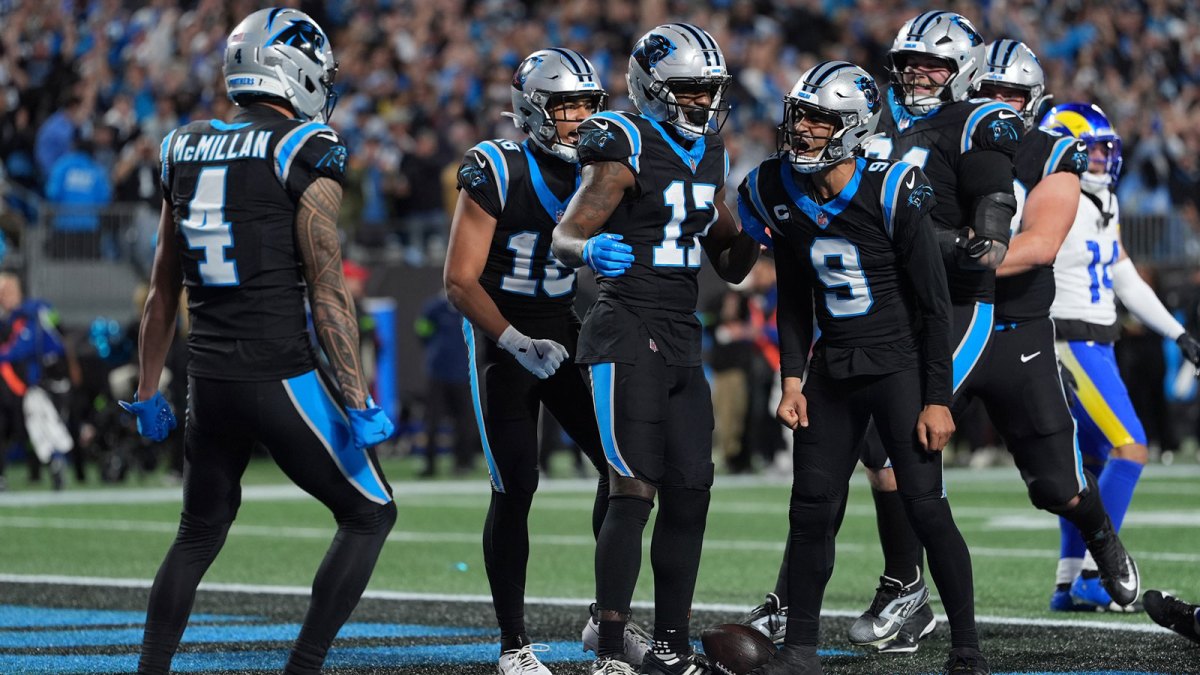
The Panthers are heading into the 2026 offseason with real momentum and a clear mission on offense. Carolina went 8-9 in 2025, still won the NFC South, and pushed the Rams to the wire in a 34-31 Wild Card loss. Now Dave Canales is doubling down on Bryce Young’s development by adding Darrell Bevell as associate head coach and offensive specialist, a longtime NFL assistant with deep experience in quarterback rooms and game planning.
That is where the salary cap becomes the adult conversation. Carolina has a credible core now, and that comes with expensive years baked into the calendar.
In 2026, several key cap hits jump north of 20 million, and that kind of clustering forces decisions. If the Panthers want to keep building around Young, they need to add one more impact skill player, or maybe a few of them, but also give space to other players to find another home.
Below are four moves Carolina should make to clear cap space in the 2026 NFL offseason.
Taylor Moton
Moton is still a quality right tackle and a stabilizer for the entire offense, especially for a quarterback who wins with timing and rhythm. His 2026 cap hit is a little over $21 million, which is a big bite for a roster that also has other heavy contracts coming due, and it is the kind of number that quietly limits what you can do in March if you leave it untouched.
The real issue is whether Carolina wants to carry a top-of-market tackle cap hit at the same time the team is trying to add another pass catcher and keep depth along the line. Offenses built around quick decisions still need a clean pocket, because even timing throws fall apart if the edge is leaking and the quarterback starts speeding up his clock.
Moton is also the kind of player coaches trust, which matters more than fans like to admit.
The move here is a restructure or an extension, depending on how the team feels about his two-year outlook. A restructure gives immediate cap relief by converting salary into bonus and spreading the charge, and it is the simplest way to create space without touching the depth chart. The drawback is obvious because it pushes money forward, so you only do it if you are comfortable with Moton staying firmly in the plan.
It also gives the team the option to stack guarantees and roster bonuses in a way that matches how the coaching staff actually expects to manage his workload.
There is also a practical team-building angle here. Carolina can chase flashy upgrades, but the fastest way to waste an offseason is to fix a secondary need while letting protection get fragile. Moton’s cap hit is one of the cleanest levers because it creates usable room without forcing a hole at a premium spot. That is what a good cap move looks like. You create flexibility, and you keep the roster functional, then you go shopping with options instead of excuses.
Robert Hunt
If Carolina wants Bryce Young to keep climbing, the interior offensive line cannot become a yearly science experiment. Hunt’s 2026 cap hit is around $24.3 million, which is massive for a guard, even a very good one. The cap move is to reshape the contract so the 2026 charge stops hogging the budget.
Restructuring Hunt can open meaningful room without changing the player or the plan, and it lets the Panthers spend elsewhere while keeping the offensive identity physical and stable. This is also one of the easiest places to create cap space because the team benefits from keeping him, and the player benefits from the security and structure.
Derrick Brown
Brown is expensive in 2026 at about $24.5 million, and he is also the kind of interior presence that keeps a defense honest. When you have a difference maker inside, your edges play faster, and your linebackers stay cleaner. A restructure here is the direct path, but they need to lower the 2026 cap hit and keep the front strong.
If you want to avoid a season where every third down feels like survival, you keep your best disruptive forces and use the cap tools available to keep the roster balanced, and this means letting Brown go.
Jaycee Horn
Corner is a tough position. If you’re thin there, you start calling defense like you’re afraid of giving up explosives, and once that happens, good quarterbacks just take what you give them and stack first downs. That’s why paying real money at the corner only makes sense if you’re getting a real return, week after week. Horn’s 2026 cap hit is around $24.08 million, and that is premium corner money, and it is only worth it if Carolina gets premium availability. The cap move depends on the team’s confidence level, and if the staff believes Horn is a long-term cornerstone, then you extend to create room while keeping a top-end coverage player.
That doesn’t mean you dump him for the sake of it. Carolina’s broader cap plan should follow the same logic because 2025 was a step forward, but not the model-year the Panthers could do. If you want 2026 to look like a repeat playoff season instead of a one-year surprise, you need enough flexibility to add actual starters.
That means smoothing out the biggest cap hits that spike in 2026 so the roster doesn’t get top-heavy. It also means protecting the offense, because the fastest way to waste a young quarterback’s progress is to let protection or weapons slip backward for financial reasons. And yes, the Panthers still have to be honest about where the roster needs help.
An 8- or 9-win team can win a division and still have obvious holes, and none of that is glamorous, but it’s exactly what decides whether you’re playing meaningful football.
Bryce Young’s comments after 2025 match what Carolina is dealing with. He talked about how thin the margin is in the NFL and how quickly outcomes can swing.
For the Panthers, that has to translate into practical roster choices. 2026 can be better than 2025, but only if the cap is handled early in the league year and not treated like a problem to clean up later.