The NBA explored a sweeping overhaul to its draft structure as part of ongoing efforts to curb tanking, including a “draft credit” system that was ultimately dismissed as too extreme, according to reporting from Jake Fischer.
The proposal, which surfaced during internal brainstorming sessions before being presented to all 30 teams at a recent Board of Governors meeting in Manhattan, would have fundamentally changed how teams acquire draft picks. Rather than tying draft position to regular-season record, the concept centered on a system of tradable “credits” used to bid on incoming rookies.
“The Stein Line has learned that one concept not currently under consideration by the league office but which sources say did get some traction in brainstorming sessions — before preferred concepts were laid out for all 30 teams at the recent Board of Governors session in Manhattan — is known as the ‘draft credit’ system,” Fischer reported.
The framework would have assigned each team an equal number of draft credits — for example, 100 — to use in an auction-style process for each pick, beginning with No. 1 overall and proceeding down the board.
“It’s a concept that would have divorced teams’ draft position from their regular season record entirely and, sources say, potentially furnished the NBA with a real-life equivalent to the way waiver budgets work in Fantasy Football,” Fischer wrote.
Teams would have been able to allocate their credits strategically, bidding aggressively for top prospects or distributing resources across multiple selections. The system also would have extended to trades, allowing teams to exchange draft credits instead of traditional picks when acquiring veteran players.
“How would this theoretically look in the NBA?” Fischer continued. “Instead of teams being granted a first- and second-round draft pick every year to keep or trade, each front office would be awarded an even number of ‘draft credits.’”
Despite generating discussion, the proposal failed to gain meaningful traction.
“It proved, in the end, to be too radical a change to gain serious support compared to the concepts that add Play-In teams to the lottery and flatten the lottery odds further that are under actual leaguewide consideration now,” Fischer wrote.
NBA presents revised lottery models as anti-tanking focus continues
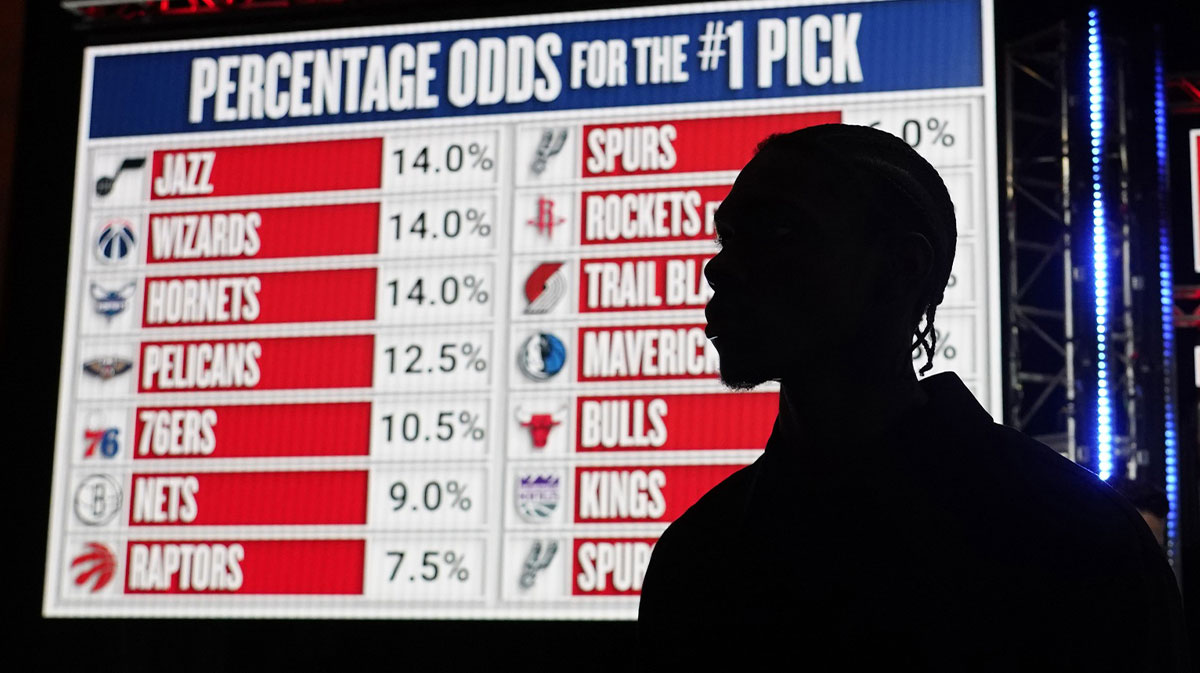
The NBA has increasingly focused on addressing tanking in recent years, particularly as teams seek higher lottery odds by prioritizing long-term rebuilding over short-term competitiveness. The league already adjusted its lottery format in 2019, flattening the odds among the three worst teams, but concerns persist about competitive integrity.
More conventional alternatives are now under active consideration ahead of a potential vote in May.
According to ESPN’s Shams Charania, the league has presented three revised lottery models to team governors.
“18 teams in draft lottery (seeds 7-15 in each conference) – flattened odds, with bottom 10 teams having an 8% chance, the remaining 20% odds distributed in decreasing order for 11 through 18, and and a lottery drawing for all 18 picks,” Charania wrote.
“22 teams in lottery using 2-year record (seeds 7-15, plus the four playoff first round exits in both conferences),” Charania continued. “Lottery teams would reach a minimum win total floor in each season, such as 25 wins. If a team falls short of the floor, it gets slotted to meet the floor. Top 4 drawn as part of lottery, as is currently.”
“18 teams in a ‘5 by 5′ lottery – bottom 5 teams have equal odds for the top pick, with lottery formed for picks 1-5. Bottom 5 teams have a floor at 10; those that fall out of top 5 get sorted in a separate drawing.”
While the draft credit system is no longer under consideration, its inclusion in early discussions reflects the league’s willingness to explore unconventional solutions as it continues refining the NBA Draft process.