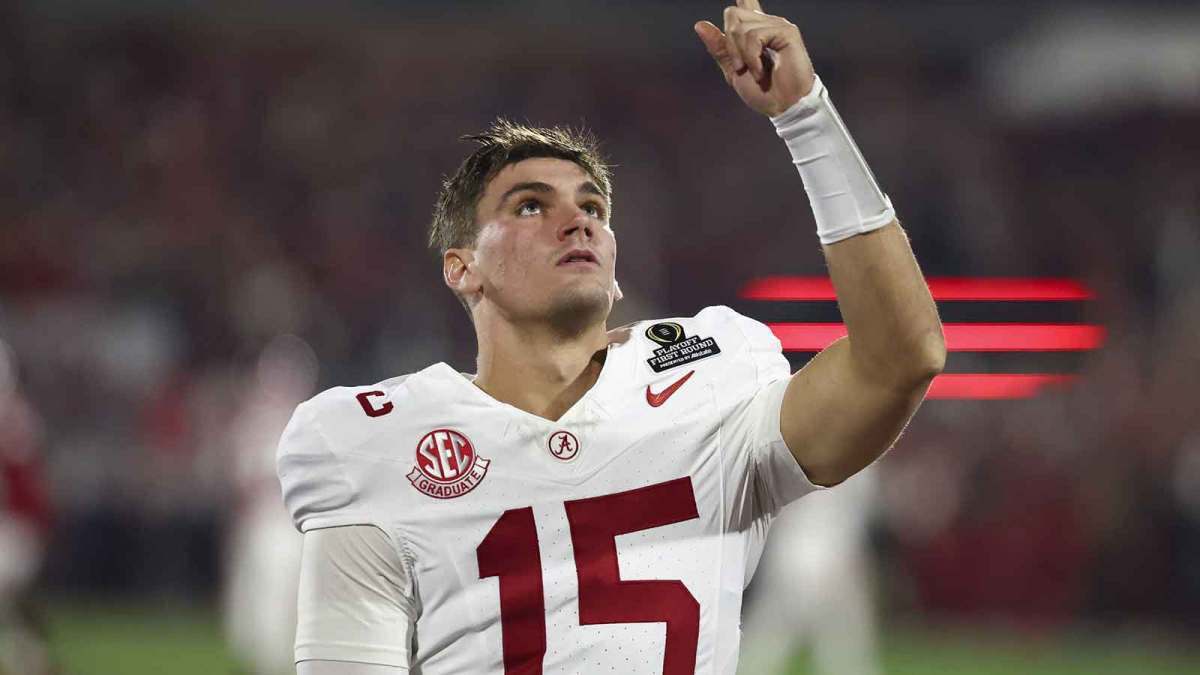
When the projected No. 1 overall pick decides to sit out the throwing drills at the NFL Draft Combine, all eyes naturally shift to the guy right behind him. For former Alabama quarterback Ty Simpson, that is exactly the opportunity he needs. Simpson will throw this week in Indianapolis, leaning into the competition while Indiana star Fernando Mendoza waits for his Pro Day on April 1.
It’s a simple business move for the redshirt junior who’s widely viewed as the QB2 of this class, trying to cement a mid-to-late first-round grade. Simpson is listed at 6-foot-2, 208 pounds, and he’s coming off the season where he finally took the reins in Tuscaloosa after waiting behind Bryce Young and Jalen Milroe, finishing 2025 with 3,567 yards, 28 touchdowns, and five interceptions while Alabama went 11-4.
Simpson’s appeal isn’t hard to explain once you watch him in a normal rhythm game. He’s at his best when the play has a clear “answer” built in, when the ball is coming out on time, and when he can live in that 8-to-18-yard area without feeling like he has to turn every snap into a rescue mission.
Here are four destinations that fit the way Simpson actually plays.
New York Jets
This is the cleanest match between the situation and draft logistics. The Jets sit near the very top of the board in 2026, and everything about their offseason points toward adding a quarterback, even if they also add a veteran. The wrinkle is that the very top of this class is expected to be expensive and crowded, which makes QB2 with first-round momentum a practical target.
Simpson fits New York because he gives them a chance to build something stable without needing a total personality transplant on offense. If the Jets commit to a timing-based system, Simpson can operate it early.
This is great in a market that punishes indecision. With Simpson, the path is at least legible.
Pittsburgh Steelers
Pittsburgh is a strong fit for one reason that matters more than buzzwords: the Steelers can draft a quarterback without making it a circus. Even when their QB room is unsettled, they tend to keep the building calmer than most, and that alone helps a young passer.
Simpson’s game lines up with what Pittsburgh wants to be when it’s at its best, and the Steelers want a run game that's good, a play-action package that punishes aggressive linebackers, and a quarterback who can win the down without treating every snap like a gamble. Simpson has enough athletic ability to survive broken pockets, but his real value is that he can work inside the structure, especially in the quick and intermediate lanes.
Draft position matters here, too. Pittsburgh is exactly the type of team that can take QB2 late in Round 1.
When you spend a top-five pick, you’re pressured to start immediately, even if the roster isn’t ready. When you take a quarterback in the back half of the first, you can be more adult about development.
And yes, there’s a real chance Pittsburgh tries to patch the position with a veteran again, but that doesn’t kill the Simpson fit. It actually helps it, because it buys him time while still giving the franchise an exit ramp that isn’t another frantic offseason.
New Orleans Saints
The Saints are a fit because they’re one of the few franchises that still treat offensive structure like religion.
That environment is friendly to Simpson. Alabama asked him to operate with discipline, and his best stretches looked like a quarterback who was comfortable playing on script, then taking the occasional shot when the defense finally overcommitted. In New Orleans, that style doesn’t get mocked.
There’s also a roster logic that makes this more than theoretical. The Saints are often managing cap gymnastics, which tends to push them toward quarterback solutions that don’t require throwing $50 million at a stopgap.
A rookie quarterback on a first-round deal changes the math. Simpson, in particular, gives them a chance to run a functional offense while the rest of the roster is being rebalanced.
If he lands there, the early goal wouldn’t be turning him into a weekly hero, but he surely can grow.
Cleveland Browns
Cleveland is the grown-up fit for Simpson. The Browns are not usually in a mood for patience, but they’re also painfully familiar with what happens when you keep chasing short-term quarterback fixes.
Simpson could be good in Cleveland because he’s the kind of quarterback who can play meaningful football without needing the offense to become a circus.
If the Browns are serious about keeping their run game identity, Simpson’s profile fits that shape. He’s comfortable off play-action, he can work the middle of the field, and he doesn’t need to throw 45 times a week to look competent.
The other reason Cleveland works is that it can support a quarterback with infrastructure. Even when the Browns are messy at QB, they’ve invested in the idea of being tough and balanced. For Simpson, that kind of environment matters more than a “star receiver” headline. You don’t want his rookie season to become 17 games of third-and-12 because the offense can’t stay ahead of the sticks.
One of the biggest storylines of Combine week is whether Simpson can turn “QB2” into a real first-round lock. That’s the question hanging over Indianapolis: if he throws well, interviews well, and looks comfortable in the setting, teams can justify taking him in the middle of Round 1 without needing a trade-up frenzy.
But if he plays ordinary, the league has a habit of pushing quarterbacks down the board until April panic sets in. Multiple draft observers have framed this Combine as the moment Simpson can either solidify first-round status or drift into that early-second gray zone.
If Simpson hits, these four teams make the most sense because they don’t require him to become a completely different player.
That’s usually what determines a quarterback’s real landing spot anyway. Not the fan argument and definitely not the internet mock, but whether the staff has a plan that matches the player they’re actually drafting.