Remember back in the glory days, when unbudging NFL head coaches stoically made their decisions? They referred to them as gut feelings. But now the NFL's analytics obsession is breaking football, and the Denver Broncos know about it, along with their head coach.
These days it’s all about percentages and likelihoods. But there is a glaring weakness with analytics. Every time you hear or see this: “The analytics say, …” you’re only getting history.
It may seem like it’s a right-now thing. But there’s no true right-now element to it. It’s predictive of what should happen, based on what has already happened in similar situations.
So, it’s the past trying to influence the future. And it’s only ever similar. Because it can never be the exact situation with so many human elements.
Coaches should not bow the knee to analytics
For example, on a given play, there are 22 grown men on the field. Fifteen of them may be fired up, tuned in, healthy, and motivated. Three of them might be hurting from the previous play. Two others might be playing with enough of an injury to be on the sidelines. One might be ready to quit the game and retire. And another might be focused on something other than football.
And when all of those individual things come together, the analytics can’t see those things.
Plus, nobody knows when a defensive player is going to make the play of his NFL life on fourth and one.
Simply put, numbers and data can’t precisely predict human outcomes. It’s probability. And for every 65 times out of 100 a situation worked, that means it failed 35 times. And who’s to say which side the coin will land on this time?
That’s where the coach’s gut instinct plays better. When analytics get too far up into the business of the most physical sport in the world, it distracts from the game. In fact, NFL teams should try their level best to prove that analytics aren’t as helpful as some portray them to be.
Just the word itself can lead to an air of superiority, according to the NBC Sports YouTube page.
“When did analytics become a bad word, here in sports?” Dan Patrick said. “Analytics sounds like, ‘I’m smarter than you.’ As opposed to (saying something like) ‘probability.’ We don’t recoil when we hear probability.”
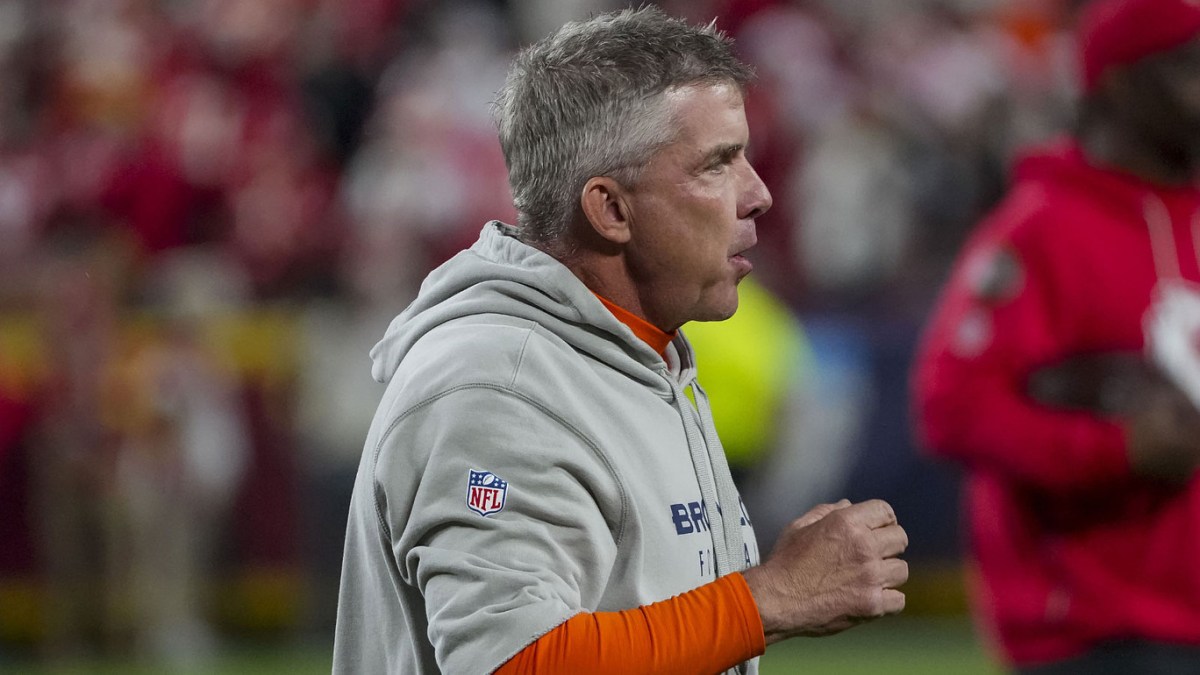
For example, let’s use Sean Payton’s decision Sunday for the Broncos against the Patriots in the AFC Championship game. In the days before analytics, a grizzled veteran like Payton might have gauged the situation differently.
But there was more to the analytics than whether Payton should go for it. There was also the question of HOW he should go for it.
“A large part of the decision-making process in analytics, as you say, is the conversion probability,” TNF analytics expert Sam Schwartzstein said. “In that fourth and one, the Next Gen stats model had them 65% to convert. But when you look at it from a run versus pass scenario, 70% on the run and 55% on the pass. And they choose to call a pass play.”
Therefore, Schwartzstein opened another issue with analytics. Now, the analytics could almost be used as an “out” for a coach. Payton just followed the analytics, in this case. But the analytics on the type of play call is just another question for the coach to answer if things go wrong.
Where the analytics model falls short
But does the model account for field conditions, crowd noise, which end of the stadium, wind factor, maybe the quarterback injured his finger on the previous play, or maybe the running back dinged his ankle? How would those things alter the analytics? They don’t, according to a post on X by the Dan Patrick Show.
“You get this sample size of data,” former NFL offensive lineman Mark Schlereth said. “But if I haven’t blocked your defensive front all day long, that data changes. If my guards can’t handle your 3-techniques. And my tackles can’t handle your defensive ends. That math doesn’t work. Math has never made a tackle. Math has never blocked anybody. You gotta understand the feel of the game. Take the points.”
At the end of the exhausting number of factors that go into the actual outcome, you’d basically need four or five different analytics numbers. And how would a coach juggle all of that in 30 seconds?
The heart of the matter is this: Analytics are computer-driven decisions in a human game. Just as no coach should ask Chat GPT what play to call, he shouldn’t rely on the analytics.
Analytics have infiltrated the game
The problem is the widely accepted usage of analytics. Who cares what that data says? Who cares about the past? The coach, in the heat of the moment, should have his finger on the pulse of his team.
You can just see old-school New York Giants head coach Bill Parcells noticing the slumping shoulders of a defensive tackle. The heaving breathing. Or old-school Washington head coach Joe Gibbs, knowing his offensive tackle has won against the man in front of him on eight straight running plays. These old-school gut feelings are what coaching is all about.
Think about it for a minute. When Washington went for it on fourth and one behind The Hogs, there was a belief among every player on the field, and every fan in the stadium — a little hyperbole, I know — that the play would succeed. It had nothing to do with percentages. It was, “My guy is tougher, meaner, stronger, and in better shape here in the fourth quarter than your guy. We’re going to pound the rock and get the first down.”
Can you imagine Gibbs having a skinny kid with a dot-matrix printout running up to him on the sideline?
“Coach Gibbs, the analytics say this gives us a 75% chance of winning if we make it!”
Yeah, not happening. The only thing Gibbs would have done is call stadium security.
This isn’t to say that head coaches these days are a bunch of number-crunching nerds. Maybe some are. Looking sideways at you, Mike Macdonald.
But it would be refreshing for somebody like Patriots coach Mike Vrabel to say, “Get out of my face with the analytics. Run the ball and get the first down.”
Analytics have their place
They do, and they can be helpful. Vrabel explained it like this when he first took over as Patriots head coach, according to patspulpit.com.
“We want to use as much information as we can to make great, informed decisions in real time, with real people,” Vrabel said during an appearance on WEEI. “Things change — the weather, the backups, who you have in the game, how their defense is playing, how their offense is playing, have you stopped them? We will always try to use that information.”
But at the end of the day, coaches are hired and fired based on whether they win or lose. No coach will keep a job based on, “I just followed the analytics.” So, NFL coaches should ignore them in the critical moments of the game.