
The 2026 NFL Draft represents a subtle but significant crossroads for the Jacksonville Jaguars. Of course, the team still believes in its offensive core led by quarterback Trevor Lawrence. However, the past season exposed some cracks across multiple layers of the roster. Defensive consistency waned late in games. The offensive line showed uneven protection, and the skill positions lacked reliable depth behind the primary starters. Without a first-round pick, Jacksonville must maximize the value of its mid-round selections. Using the PFF mock draft simulator after the NFL Combine, this projected class reveals a team prioritizing offensive versatility, defensive instincts, and physical depth across the roster.
Draft priorities

Heading into the 2026 NFL Draft, the Jaguars face several structural needs across the roster. Lawrence absolutely remains the franchise centerpiece. Still, the team has explored developmental quarterback depth to stabilize the position long term. On defense, the interior defensive line requires reinforcements to complement the current front. Meanwhile, linebacker depth remains a concern after inconsistent performances during the 2025 campaign. The safety room also lacks proven stability and playmaking range. That creates urgency to add a player capable of reading the field and generating turnovers. With no first-round pick available, Jacksonville’s approach emphasizes athletic depth and players who can grow into larger roles over time.
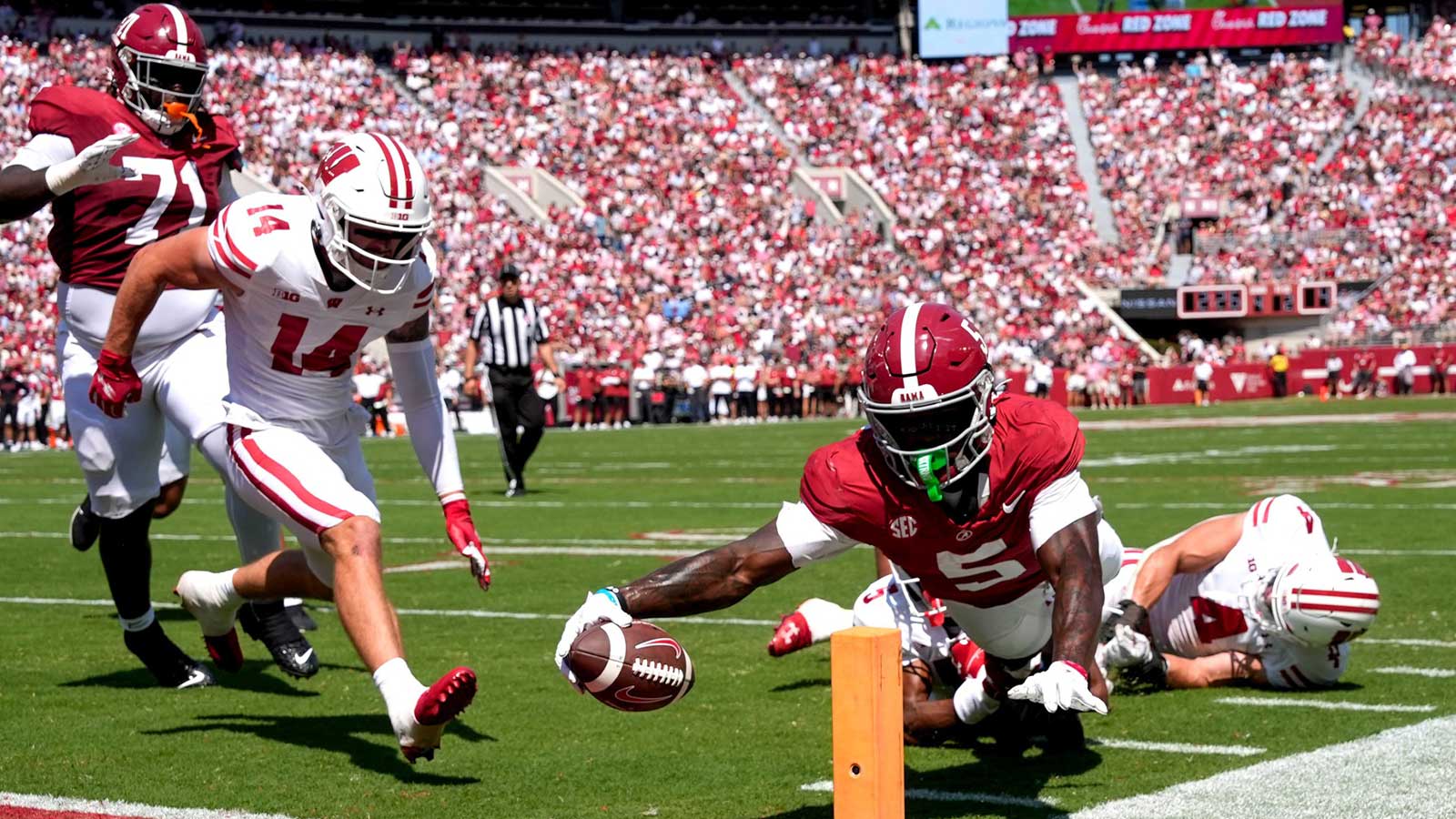
Round 2, pick 56: WR Germie Bernard, Alabama
Bernard’s college journey across multiple programs ultimately helped shape a versatile receiver. With good size, strength, and straight-line speed, Bernard can line up outside, in the slot, or in motion packages.
His game thrives on vertical routes and deep crossers where his stride and physicality shine. Yes, he may not dominate any single trait category. That said, Bernard’s versatility fits Jacksonville’s offensive system well. In a passing attack built around Lawrence, Bernard projects as a valuable complementary target who can stretch defenses vertically.
Round 3, pick 81: RB Jonah Coleman, Washington
Coleman brings a physical presence to Jacksonville’s backfield rotation. At over 225 pounds, he combines size with balance and surprising lateral agility. His ability to absorb contact and push through tackles makes him a natural between-the-tackles runner.
Sure, his acceleration and top-end speed may limit explosive plays. However, Coleman’s reliability in pass protection and his dependable hands as a receiver elevate his value. In a two-back committee, he could become the Jaguars’ power option who sustains drives and stabilizes the offense in short-yardage situations.
Round 3, pick 88: OL Gennings Dunker, Iowa
Dunker arrives with one of the more battle-tested résumés in the class after starting at tackle for Iowa over multiple seasons. However, his physical profile suggests a transition to guard at the professional level.
Inside, Dunker’s strengths become more pronounced. His hulking frame and wrestling background give him excellent leverage and balance at the point of attack. In a zone-based blocking system, moving him to guard allows Jacksonville to maximize his power while minimizing limitations in pass protection.
Round 3, pick 100: S Genesis Smith, Arizona
Genesis Smith offers intriguing ball-hawking instincts that Jacksonville’s secondary has lacked at times. His ability to anticipate quarterback decisions allows him to jump passing lanes and create turnovers.
However, Smith’s run defense and tackling consistency remain areas of concern. Too often he misses open-field tackles or allows ball carriers to break through initial contact. For Jacksonville, Smith represents a classic Day 3 gamble. He brings elite instincts in coverage paired with developmental needs in run support.
Round 4, pick 124: LB Taurean York, Texas A&M
York might become one of the most impactful picks in this class. Though slightly undersized, he compensates with elite instincts, leadership, and tackling consistency.
A defensive captain since his freshman season, York operates as the quarterback of the defense. His ability to diagnose plays quickly and attack the ball carrier makes him a natural MIKE linebacker candidate. Coaches will appreciate both his motor and his football IQ. These traits often translate quickly to the professional level.
Round 5, pick 162: WR Reggie Virgil, Texas Tech
Virgil brings a blend of competitiveness and technical skill that could translate well as a depth receiver. After transitioning from the MAC to the Big 12, he demonstrated the ability to maintain production against stronger competition.
He has good body control and the ability to win contested catches. With that, Virgil profiles as a potential WR4 option with special teams value. His well-rounded skill set gives Jacksonville another depth piece in the receiving corps.
Round 5, pick 164: OL Ar’maj Reed-Adams, Texas A&M
Reed-Adams offers a physical, downhill presence in the interior offensive line. His wide base, strength, and arm length make him difficult to beat in pass protection.
Yes, his lateral quickness may limit effectiveness in certain zone-blocking scenarios. That said, Reed-Adams thrives in power-based schemes. That's where he can climb to the second level and deliver punishing blocks. For Jacksonville, he adds much-needed depth and toughness to the offensive front.
Round 7, pick 233: DL Rayshaun Benny, Michigan
Benny has quietly developed into a dependable rotational defender during his time at Michigan. Though slightly lighter than some interior linemen, he compensates with good technique and awareness.
His understanding of hand usage and pass-rush moves provides versatility along the defensive front. He may never become a dominant interior force. Despite that, Benny projects as a reliable depth piece capable of contributing in multiple defensive alignments.
Round 7, pick 245: EDGE Patrick Payton, LSU
Payton represents a classic late-round upside swing. His athleticism and length make him an intriguing developmental edge rusher.
His technique and leverage may remain inconsistent. Payton’s long-arm pass-rush move, though, shows legitimate potential. In the right system, particularly as a 3-4 edge rusher, he could evolve into a situational pass-rush contributor.
Depth and versatility
Without a first-round pick, Jacksonville’s strategy centers on depth, versatility, and long-term development. Bernard strengthens the receiver room, Coleman stabilizes the backfield rotation, and Dunker fortifies the offensive line.
Meanwhile, York and Smith inject athleticism and instincts into the defense. Meanwhile, the later selections add competition and rotational value across multiple positions.
This PFF mock draft may lack headline names, but it reflects a disciplined roster-building approach. By targeting versatile offensive weapons and instinctive defensive playmakers, the Jaguars position themselves to strengthen multiple layers of the roster. If even a handful of these selections reach their potential, Jacksonville could quietly assemble one of the more balanced draft classes of 2026.