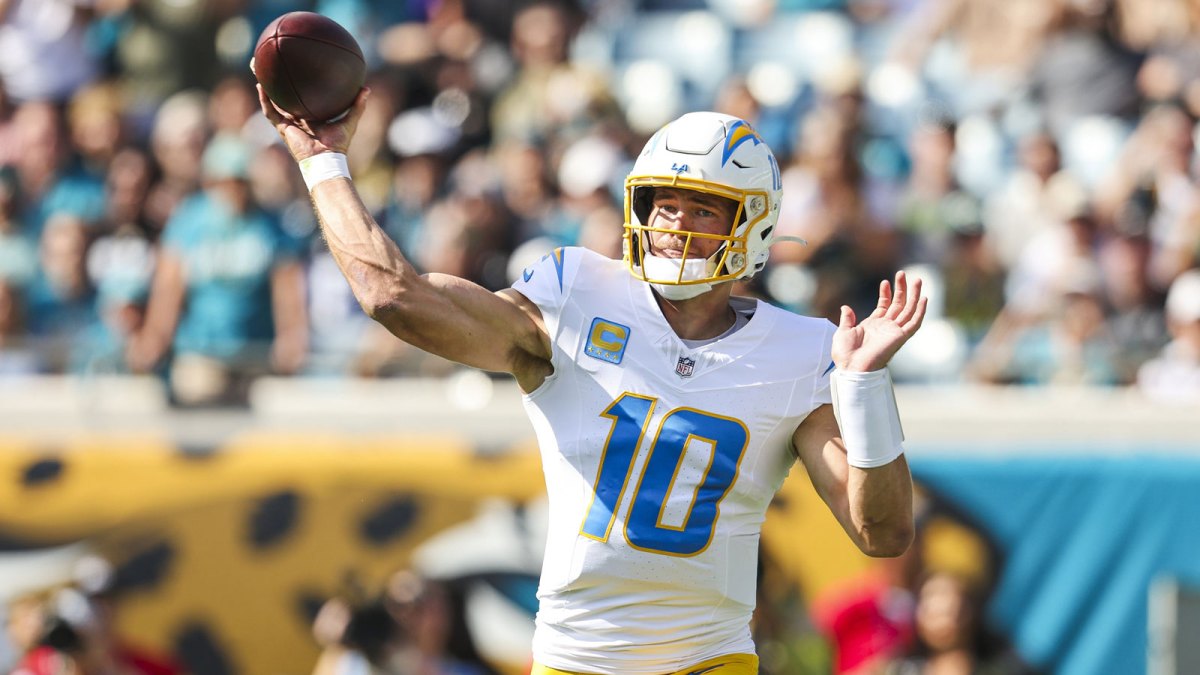
The Chargers spent the first part of the offseason doing exactly what their recent coaching and front-office decisions indicated they would do. They signed former Dolphins guard Cole Strange to a two-year, $13 million deal, reuniting him with offensive coordinator Mike McDaniel and giving Los Angeles another player familiar with McDaniel’s offense.
They also signed former Ravens tight end Charlie Kolar to a three-year, $24.3 million contract that makes him the highest-paid blocking tight end in the league, another move that aligns with Jim Harbaugh’s preference for physical offense and Joe Hortiz’s Baltimore connections. Neither move alone changes the draft plans, but both point in the same direction.
So, Los Angeles is at No. 22, in a range where teams usually must decide what they trust most. The Chargers can justify selecting interior offensive line help because last season’s interior was not good enough, and free agency has not fixed everything.
After Indianapolis, mock drafts for the Chargers have focused on these options, and unlike some teams, Los Angeles doesn’t seem limited to a single narrow choice.
G Olaivavega Ioane, Penn State
Tim Crean offers a straightforward pick, projecting the Chargers select Penn State guard Olaivavega Ioane at No. 22.
He reasons that Los Angeles needs interior line help to protect Justin Herbert and improve the run game, and Ioane is the best true guard in the class, so there’s no need to overthink it. That’s basically the entire pitch.
If you watched the Chargers struggle inside last season, you will know why this is. And, of course, the tackles weren’t the only issue, as the interior was too soft, inconsistent, and easily disrupted by movement.
McDaniel’s offense can create angles and use motion to boost the run game, but if the guards can’t hold up, the whole scheme feels more clever than solid. Ioane is a good choice because he appears ready to start quickly at a position that actually needs help.
He also resembles the type of lineman Harbaugh often favors. He has enough size, power, and straightforward physicality that the fit is obvious.
The Chargers already took a big swing on tackle Joe Alt, and adding a player like Ioane would be the next step, as someone who allows the offense to stop asking Herbert to survive protection issues and instead rely on the line to carry more weight.
It may not be glamorous, but it’s exactly what a team that believes it can contend needs and fewer weak points.
OT Kadyn Proctor, Alabama
Jordan Reid projects Alabama tackle Kadyn Proctor to the Chargers, and this is where the discussion gets more interesting.
Reid noted a real divide among scouts in Indianapolis; some see a first-round talent, others see a Day 2 player.
He also highlights the position debate: Proctor played tackle in college, but many evaluators believe he could shift inside to guard in the NFL.
Reid reasons that even if Proctor moves inside, he still provides Los Angeles with insurance at tackle, especially after injuries to Joe Alt and Rashawn Slater last season.
This dual-position possibility is more important than it seems, of course.
The Chargers need a better backup plan if the line faces stress from injuries or inconsistent play again. Proctor is a nice addition because he offers flexibility without feeling like a compromise, and if he becomes a guard, the Chargers gain rare size and movement inside. If he moves outside in an emergency, the team doesn’t have to overhaul their entire offense.
Proctor is massive, and his best plays look like those Harbaugh offenses favor, overwhelming opponents with size and physicality.
His body type alone makes teams consider what he could become in a more stable pro system.
The only concern is that he’s still a projection to some degree, but at No. 22, on a roster that already added veterans like Strange and Kolar, that projection becomes more manageable because he’s not expected to carry the whole line right away.
DT Caleb Banks, Florida
Lance Zierlein predicts that the Los Angeles Chargers will select Florida defensive tackle Caleb Banks. He reasons that Banks is one of the most physically gifted defenders in this draft.
Although durability has been a concern, it would be difficult for the Chargers to overlook such a talented player if he is still available at pick 22.
This projection seems plausible because front-office decisions are not always made purely based on need. Sometimes, a player falls into the right draft range, leading a team to envision the potential impact that player could have on its defense if their raw traits translate into production.
Banks is the type of player who encourages such discussions, and while defensive tackle may not be the Chargers' most pressing need, they wouldn’t automatically overlook a high-end talent.
If a player can dominate inside and alter blocking schemes, it can simplify defensive strategies.
For the Chargers, they can enhance their offensive line through various methods and have already begun addressing offensive needs in free agency.
If, at 22, they have the chance to select a premium defensive tackle rather than a more conventional guard or tackle, this is the kind of team that might justify that selection by asserting that they can still address the offensive line later.
Rare interior defenders are not always available, and Zierlein’s mock draft suggests a team focusing on superior talent rather than purely on its needs.
DL Peter Woods, Clemson
Nate Tice and Charles McDonald, Yahoo Sports
Nate Tice and Charles McDonald link Peter Woods to the Chargers, emphasizing the idea of simply selecting the best player available.
Their argument, as reflected in the Chargers' draft tracker, is that Woods entered the year as a potential top pick.
Despite having a down season in a struggling Clemson program, he still possesses the potential to be an impact player on the defensive interior.
They also highlight the synergy between Woods and edge rusher Tuli Tuipulotu, framing Woods as part of a cohesive front rather than just an isolated talent.
Woods would be chosen by a Chargers team that believes its defense needs another disruptive player rather than just another rotational option.
He is not limited to playing as a pure nose tackle or a one-gap specialist; instead, he is the type of interior player who can discomfort offensive lines, which benefits edge players like Tuipulotu.
If they choose Woods, they are betting that strengthening their defensive front can be nearly as valuable as addressing their guard situation.
What's next for the Charges?
There is some risk in this approach, as the offensive line issue is a concrete problem rather than a theoretical one.
However, there is also a rationale in avoiding panic-driven drafting, and selecting Woods would not indicate that the team is ignoring offensive needs, but it would show they are committed to acquiring premium talent in the trenches, regardless of what their current depth chart indicates is most urgent.
The post-Combine analysis of the Chargers reflects a clear sentiment within the league: analysts are not predicting wide receivers or flashy playmakers for them. Most of the focus is on strengthening both the offensive and defensive lines players who impact the game before the ball is even in motion.
While Strange and Kolar may not have been attention-grabbing signings, they were strategically important, and the approach for the draft at No. 22 appears to follow this same trend.
For a team aiming to elevate a good roster into one capable of competing, this pragmatic strategy makes more sense than chasing glamour.